
New Zealand vs India, 1st ODI, India Tour of New Zealand 2026: Match Preview, Pitch Report, Toss Prediction and Fantasy Tips
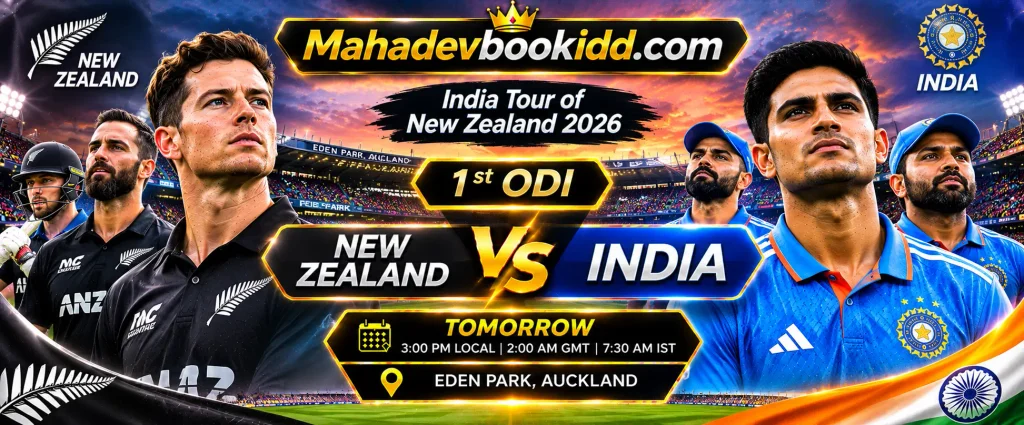
The New Zealand vs India 1st ODI at Eden Park on Wednesday, 4 November 2026, marks the beginning of a five-match series that carries significance beyond the immediate result. For India, it is the return of Rohit Sharma and Virat Kohli to the 50-over format, possibly for the final time on New Zealand soil, and the first real step in the build-up to the 2027 World Cup. For New Zealand, it is an opportunity to test a squad stripped of Rachin Ravindra and Mark Chapman through injury, against the side that has beaten them in seven consecutive ODIs.
This preview breaks down everything that matters for the series opener: the confirmed match details, the peculiar challenges of Eden Park, the weather forecast, both squads, the toss dynamics, key player matchups, probable XIs, fantasy cricket angles, and a reasoned winner prediction. The goal is to separate verified information from analysis, and to give readers a clear picture of what to expect from a venue that has historically not been kind to India.
New Zealand vs India 1st ODI: Match Details
The series opener is a day-night fixture at a venue with a capacity of 41,000, and the unique dimensions of Eden Park make it one of the most distinctive grounds in world cricket.
| Detail | Information |
|---|---|
| Match | New Zealand vs India, 1st ODI |
| Series | India tour of New Zealand 2026 |
| Date | Wednesday, 4 November 2026 |
| Local Time | 3:00 PM NZDT |
| IST | 7:30 AM |
| GMT | 2:00 AM |
| Venue | Eden Park, Auckland |
| Format | ODI (50 overs) |
The match is the first of five ODIs, with the series moving to Wellington, Hamilton, and Mount Maunganui after the Auckland opener.
Match Preview: A Series of Contrasts
India arrive in Auckland with momentum from a 3-2 T20I series victory, though the last two matches were dead rubbers that New Zealand won. The return of Rohit and Kohli transforms the batting order. Rohit, 39, comes into the series on the back of a century in England and another hundred plus a 91 against the West Indies. Kohli, 37, struck his 55th ODI century against the West Indies and remains, in the words of the Deccan Herald, “fit and firing like he was a decade ago”.
New Zealand are without Rachin Ravindra and Mark Chapman, both ruled out through injury, and have recalled Tim Seifert and Henry Nicholls as replacements. Mitchell Santner leads a split squad, with the red-ball players departing after the third ODI to prepare for the Test series beginning on 19 November. The hosts’ last ODI assignment was a 3-2 series win in the West Indies in July, and they have won nine of their last ten completed ODIs, a run that stretches back to the 2025 Champions Trophy final defeat to India.
The central tension of this fixture is whether India’s experienced batting line-up can adapt to Eden Park’s unusual dimensions, and whether New Zealand’s injury-depleted squad has enough depth to exploit them.
Eden Park Pitch Report: Small Boundaries, Big Scores
Eden Park is not a conventional cricket ground. Its rectangular shape means the straight boundaries are under 60 metres, and top edges that would be caught at other venues can fly for six. The pitch itself is a flat, high-scoring batting track. The average first-innings score at the venue is 222, the average second-innings score is 195, and the highest total recorded is 340 for 5 by New Zealand against Australia in 2007.
This is a venue where bowlers must be precise with their lengths. The new ball can swing, particularly under the afternoon sun, but the short boundaries punish anything overpitched or short and wide. Spinners are not automatic beneficiaries of the conditions; they must use the bounce and vary their pace to avoid being hit into the stands.
The first innings is likely to be a high-scoring affair. A total below 280 would be below par, and anything above 320 would put significant pressure on the chasing side. The team batting first will look to set a total, but the chasing team’s advantage at Eden Park is not as pronounced as at some other venues because the boundaries remain small throughout the match.
Auckland Weather Report: Morning Rain, Clear Evening
The weather forecast for match day carries a meaningful caveat. According to AccuWeather, there is a 56% chance of rain in the morning, but the afternoon and evening are expected to remain clear. The temperature will hover around 19°C at the start of the match and drop to 17°C by night, which is chilly for a day-night ODI in November.
The key question is whether the morning rain affects the pitch preparation. If the covers are on for an extended period, the surface may retain more moisture than usual, which could assist the seamers early on. However, the forecast suggests the rain will clear well before the 3:00 PM start, and a full 50-over contest is the most likely outcome.
New Zealand Team Overview: Depleted but Dangerous
New Zealand’s squad for the first three ODIs is missing two of its most important batters in Rachin Ravindra and Mark Chapman. The recall of Tim Seifert and Henry Nicholls adds experience, but the batting order will look different from the one that has been building towards the 2027 World Cup.
Batting: Devon Conway, Will Young, Daryl Mitchell, and Glenn Phillips form the core. Tom Latham keeps wicket and bats in the middle order. Michael Bracewell provides all-round depth. The absence of Ravindra and Chapman removes two left-handed options and reduces the flexibility of the line-up.
Bowling: Matt Henry leads the pace attack, with Kyle Jamieson, Jacob Duffy, Nathan Smith, and Blair Tickner providing seam options. Mitchell Santner captains and bowls left-arm spin, while Bracewell offers off-spin. The bowling attack is experienced, but the absence of a frontline left-arm seamer beyond Santner limits the variety.
All-rounders: Bracewell, Santner, and Mitchell are all capable of contributing with both bat and ball. This gives the captain flexibility, but the depth beyond the top six is thinner than India’s.
India Team Overview: Experience Returns
India’s squad for the first three ODIs is led by Shubman Gill, with Shreyas Iyer as vice-captain and KL Rahul keeping wicket. The return of Rohit and Kohli is the headline, but the supporting cast is equally important.
Batting: Rohit and Kohli at the top, with Gill, Iyer, and KL Rahul forming a formidable middle order. Ruturaj Gaikwad and Ishan Kishan provide additional options. Nitish Kumar Reddy is available for the first ODI only, adding a power-hitting all-round option. The batting depth is arguably the strongest in the world.
Bowling: Jasprit Bumrah is rested and Prasidh Krishna is injured, which means Mohammed Siraj leads the pace attack. Arshdeep Singh, Anshul Kamboj, and Auqib Nabi provide seam options, while Kuldeep Yadav is the frontline spinner. Axar Patel offers left-arm spin and lower-order batting. The absence of Bumrah is a significant loss, but the depth is sufficient to cover it.
All-rounders: Axar, Nitish Reddy, and Naman Dhir give the captain options with both bat and ball. The balance of the XI will depend on whether India choose to play three seamers, two spinners, or a combination that includes an extra all-rounder.
Head-to-Head Record: India’s Eden Park Struggle
India’s overall ODI record against New Zealand is strong, but Eden Park has been a problematic venue. India have won just four of their 11 ODIs against New Zealand at the ground, including a seven-wicket defeat on their last visit in 2022. The venue’s short boundaries and the conditions under lights have historically favoured the hosts.
The broader head-to-head, however, leans heavily towards India. They have won their last seven ODIs against New Zealand and enter the series as favourites. The challenge for India is not the opposition’s overall quality but the specific demands of a venue where they have struggled.
Toss Prediction: Batting First for Scoreboard Pressure
The toss at Eden Park is less about dew and more about scoreboard pressure. The pitch is a batting surface, and the team batting first has the opportunity to set a total that forces the chasing side to take risks on a ground where boundaries are short but the required rate can climb quickly if wickets fall.
The historical data suggests that batting first is not a guaranteed advantage — the average first-innings score is 222, but the average second-innings score is 195, which indicates that chasing teams have often fallen short. The team winning the toss is likely to bat first, backing their batting line-up to post a total above 300.
For India, batting first would allow Rohit and Kohli to set the tone without the pressure of a required rate. For New Zealand, batting first would give their bowlers a total to defend and put pressure on India’s middle order.
Probable Playing XIs
New Zealand Probable XI
| Player | Role |
|---|---|
| Devon Conway | Top-order Batter |
| Will Young | Top-order Batter |
| Kane Williamson | Batter |
| Daryl Mitchell | All-Rounder |
| Tom Latham (wk) | Wicketkeeper-Batter |
| Glenn Phillips | Middle-order Batter |
| Michael Bracewell | All-Rounder |
| Mitchell Santner (c) | Spin Bowler |
| Matt Henry | Pace Bowler |
| Kyle Jamieson | Pace Bowler |
| Jacob Duffy | Pace Bowler |
India Probable XI
| Player | Role |
|---|---|
| Rohit Sharma | Top-order Batter |
| Shubman Gill (c) | Top-order Batter |
| Virat Kohli | Top-order Batter |
| Shreyas Iyer | Middle-order Batter |
| KL Rahul (wk) | Wicketkeeper-Batter |
| Nitish Kumar Reddy | All-Rounder |
| Axar Patel | All-Rounder |
| Kuldeep Yadav | Spin Bowler |
| Mohammed Siraj | Pace Bowler |
| Arshdeep Singh | Pace Bowler |
| Auqib Nabi | Pace Bowler |
Note: These XIs are probable combinations based on squad composition and recent selection patterns. The final XIs will be confirmed at the toss.
Key Players to Watch
Rohit Sharma (India): The most important batter in the line-up. His ability to score quickly in the powerplay sets the tone for the innings, and his record at Eden Park will be tested against a disciplined New Zealand pace attack.
Virat Kohli (India): His 55th ODI century against the West Indies underlined his enduring quality. On a ground with short boundaries, his ability to find gaps and rotate strike will be crucial.
Devon Conway (New Zealand): The left-handed opener is the anchor of New Zealand’s batting. His performance against India’s seamers in the powerplay will determine whether the hosts can post a competitive total.
Daryl Mitchell (New Zealand): The all-rounder is one of the most valuable players in the squad. His middle-order batting and seam bowling give the captain options in multiple phases.
Kuldeep Yadav (India): With Bumrah absent, Kuldeep’s spin is India’s most potent wicket-taking weapon. On a pitch that offers bounce, his variations could be decisive in the middle overs.
Matt Henry (New Zealand): The pace bowler is New Zealand’s most reliable new-ball option. His ability to swing the ball and take early wickets will be critical against India’s star-studded top order.
Fantasy Cricket Tips: Framework for Dream11
Fantasy selections should always be provisional until the confirmed XIs are announced. The recommendations below are based on probable XIs, player roles, and venue conditions.
Wicketkeepers: KL Rahul and Tom Latham are the premium options. Rahul’s batting position in the top five gives him more opportunities to score, while Latham’s middle-order role and keeping points make him a reliable alternative.
Batters: Rohit Sharma, Virat Kohli, and Shubman Gill are the premium batting options for India. Devon Conway and Daryl Mitchell are the corresponding choices for New Zealand. On a high-scoring ground, selecting at least four specialist batters is advisable.
All-rounders: Axar Patel, Nitish Kumar Reddy, Michael Bracewell, and Mitchell Santner are the leading all-rounder options. Axar and Bracewell are the safest picks because of their dual roles.
Bowlers: Kuldeep Yadav and Matt Henry are the premium bowling options. Mohammed Siraj and Kyle Jamieson are the pace alternatives. On a batting-friendly pitch, selecting bowlers who take wickets rather than those who merely contain is the better strategy.
Captain and Vice-Captain: Rohit Sharma and Virat Kohli are the strongest captain candidates because of their batting ceilings. For vice-captain, Kuldeep Yadav and Daryl Mitchell offer all-round potential.
Reminder: Fantasy cricket involves risk, and no selection guarantees points. Use these recommendations as a framework, not a guarantee.
New Zealand vs India 1st ODI: Winner Prediction
India enter the match as marginal favourites. The return of Rohit and Kohli transforms the batting line-up, and the depth of the squad is superior to New Zealand’s injury-depleted resources. India’s recent head-to-head record against New Zealand is also strongly in their favour.
However, Eden Park’s unique dimensions and India’s poor record at the venue introduce uncertainty. New Zealand’s pace attack, led by Matt Henry and Kyle Jamieson, is capable of exploiting any early movement, and the short boundaries can amplify the impact of a single aggressive innings.
On balance, India are the more likely winners, but the margin is not large enough to make this a confident prediction. If New Zealand win the toss and bat first, the pressure on India’s middle order could produce a closer contest than the head-to-head record suggests.
Conclusion
The New Zealand vs India 1st ODI at Eden Park is a contest between India’s experienced batting line-up and New Zealand’s resilient, if depleted, squad. The pitch is a batting surface with short boundaries, the weather is expected to clear after morning rain, and the toss will likely determine whether the match is a high-scoring chase or a defence of a total above 300. Rohit Sharma and Virat Kohli return to the ODI side for what may be their final tour of New Zealand, and their performances will shape the series. India are the marginal favourites, but Eden Park’s history suggests that the hosts cannot be counted out.